Deterministic delivery and security for AI-built software.

Ship AI-generated code with control.

securecod.eu puts AI-generated code through deterministic security and deployment gates before it reaches production.

Controlled access

GitHub App access that stays scoped and revocable.

Traditional tools

Security scanners find issues before release decisions.

AI analysis

AI explains logs, findings, and next actions.
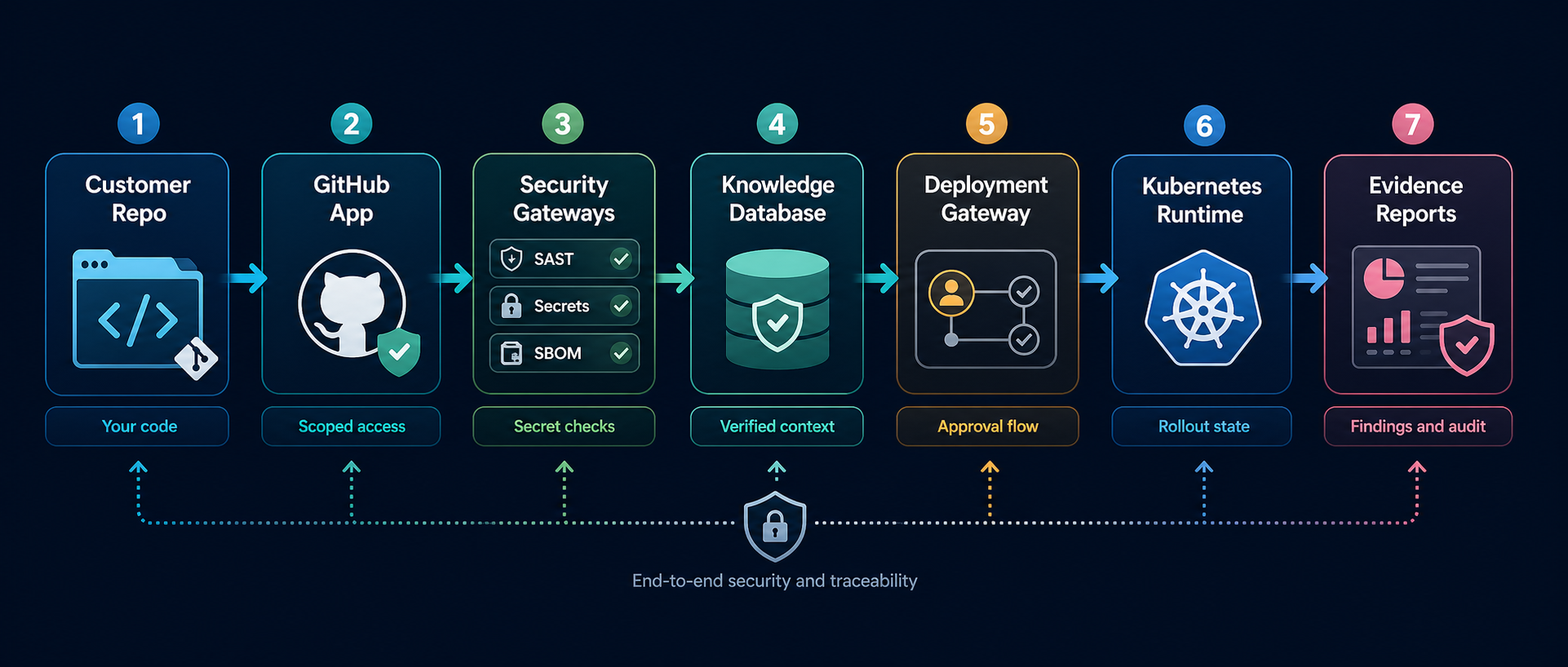
End-to-end delivery path from customer repository and GitHub App through security gateways, knowledge database, deployment gateway, Kubernetes, and reports.

Why this exists

AI coding speed outpaces review and deployment controls.

Teams need explicit signals for access, checks, rollout, and approval.

Review risk

Large AI-generated PRs are hard to review.

Output grows faster than evidence.

Runtime drift

Deployment assumptions diverge from reality.

Generated code often targets the wrong runtime.

Security hygiene

Findings get fragmented across tools.

Security logs and scan outputs need clear triage.

What the platform does

Traditional security tools find issues. AI helps explain what they mean.

Operators stay in control before code reaches production.
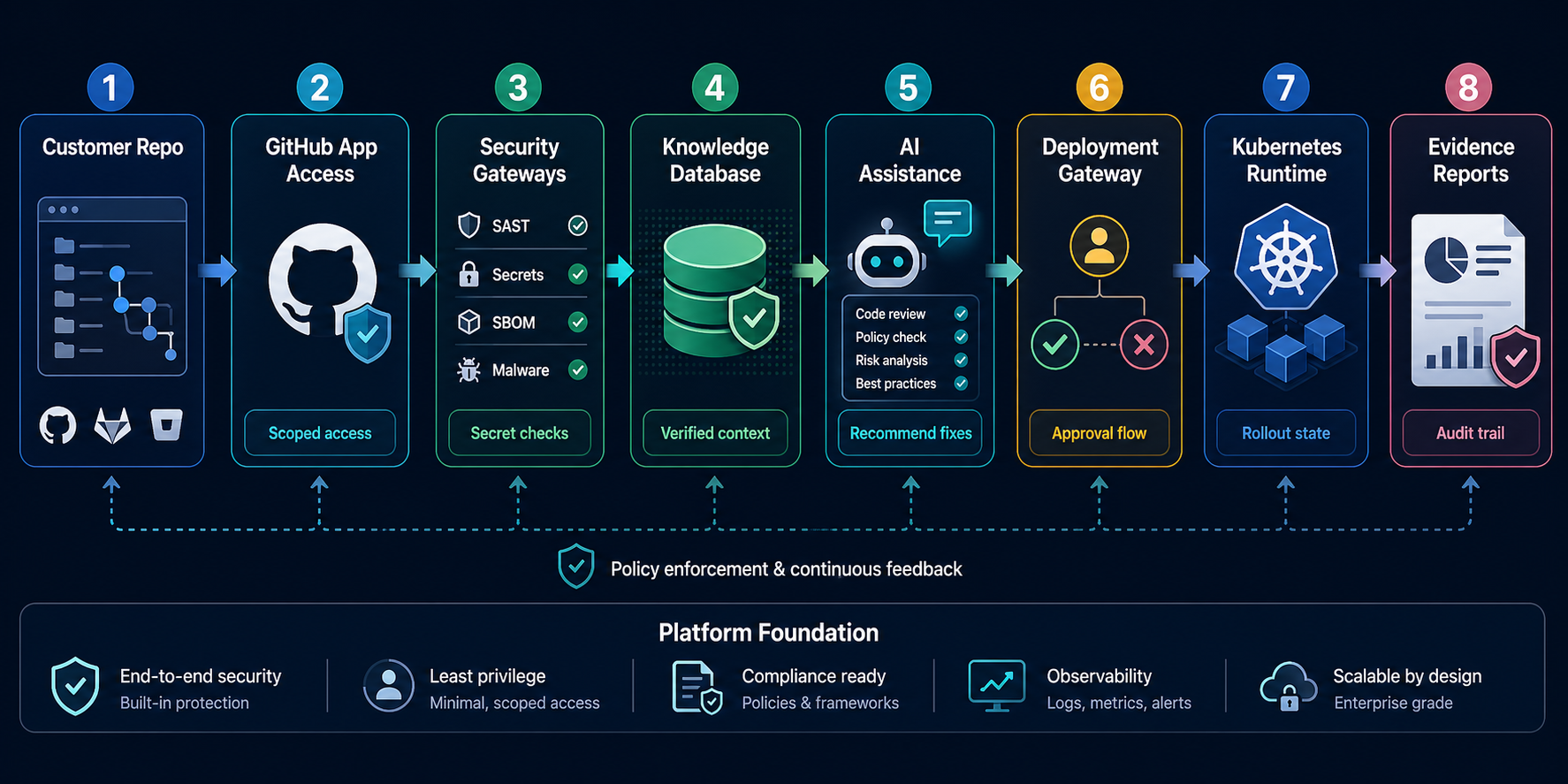
  1. Connect the repository through GitHub App.
  2. Run deterministic security and deployment gateways.
  3. Use AI to analyze logs, findings, and follow-up actions.
  4. Deploy and review evidence in one visible path.
Platform overview from customer repository and GitHub App through security gateways, knowledge database, deployment control, Kubernetes runtime, and evidence reports.

Core gateways

Security and deployment are the primary control points.

Core release control starts with these two gateways.

Security Gateway

Core

Runs exposure, secret, and hygiene checks before release.
  • Repository exposure scan
  • Secret and hygiene checks
  • Triage-ready findings

Deployment Gateway

Core

Controls approvals, rollout policy, runtime state, and evidence.
  • Deterministic rollout flow
  • Policy and approval gates
  • Logs and evidence capture

Knowledge Database

Secondary

Provides verified project context for operators and agents.
  • Repository and docs retrieval
  • Verified project context
  • Shared operator memory

AI Playground

Secondary

Gives operators a controlled place to inspect and follow up on AI-assisted work.

  • Operator-controlled agent flows
  • Task threads and runtime history
  • Evidence-aware execution

Next layer

Test / Confidence Gateway

Readiness signals for merge and deploy decisions.

AI Error Pattern Gateway

Recurring AI failure patterns turned into operational feedback.

Positioning

Deterministic security first. AI analysis second.

Security tools produce evidence. AI helps operators understand logs, findings, and next actions.

Founders / CTOs Engineering managers Platform / DevOps Security-minded product teams

Common use cases

Three primary buying scenarios.

  • Merge control: Review AI-generated pull requests before merge.
  • Controlled rollout: Deploy through Kubernetes workflows with visible rollout state.
  • Verified context: Give agents project context with operator supervision.

Repository onboarding

GitHub App keeps access scoped, revocable, and customer-controlled.

Use installation access instead of a shared operator login.
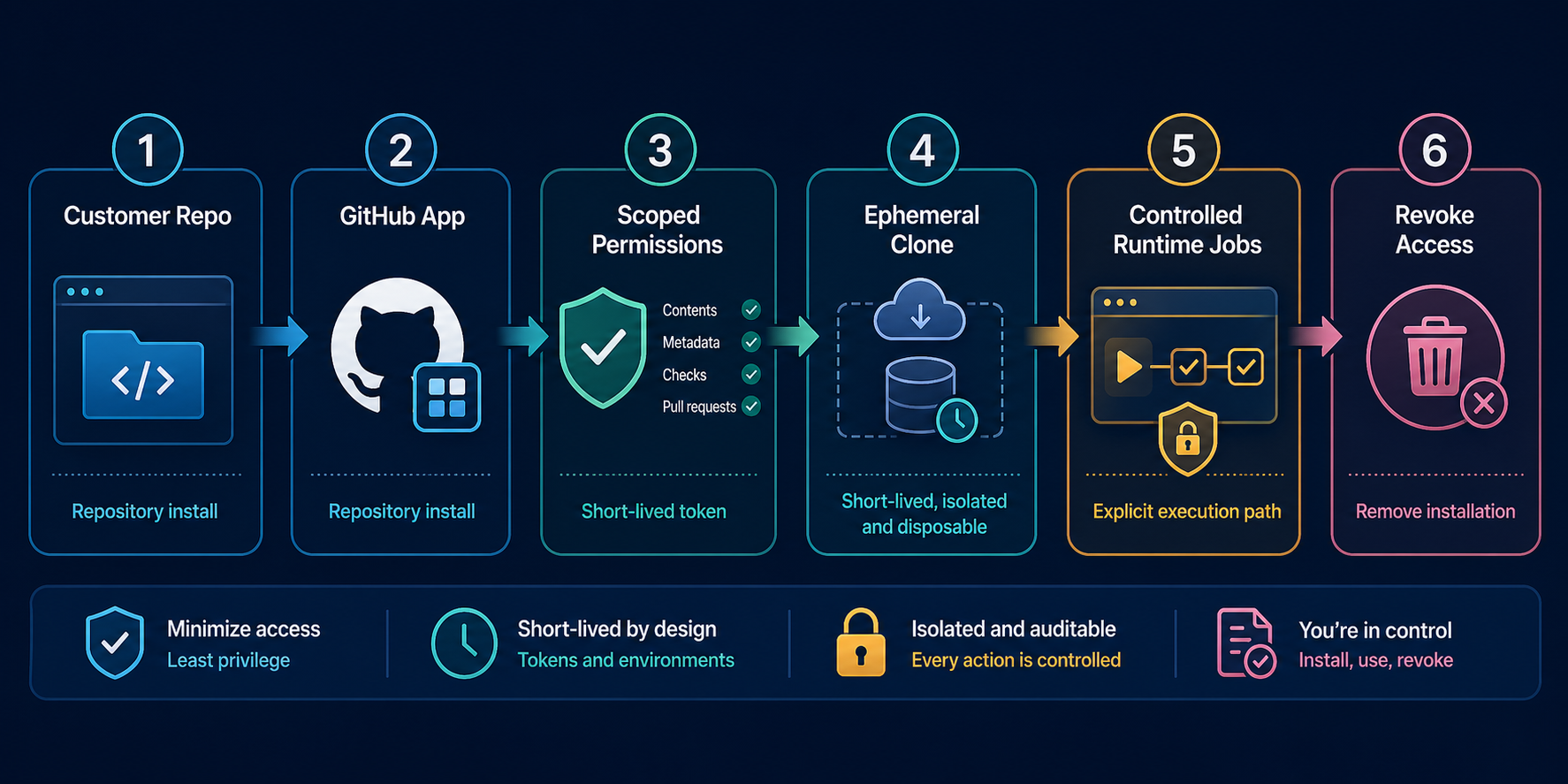
  • Repository-scoped permissions
  • Least-privilege access path
  • Revocation by removing the installation
Customer repository onboarding through GitHub App, scoped permissions, ephemeral clone, and revoke path.

Kubernetes and runtime model

Use a predictable runtime instead of ad hoc deployment drift.

Kubernetes makes rollout and rollback easier to reason about.

  • Single-node for compact controlled environments
  • Lightweight multi-node for stronger separation

Deterministic first, AI second

AI can assist. It should not replace the control layer.

Security signals, deployment state, and approvals stay explicit facts.

  • Deterministic checks before AI interpretation
  • Explicit approvals and audit trail